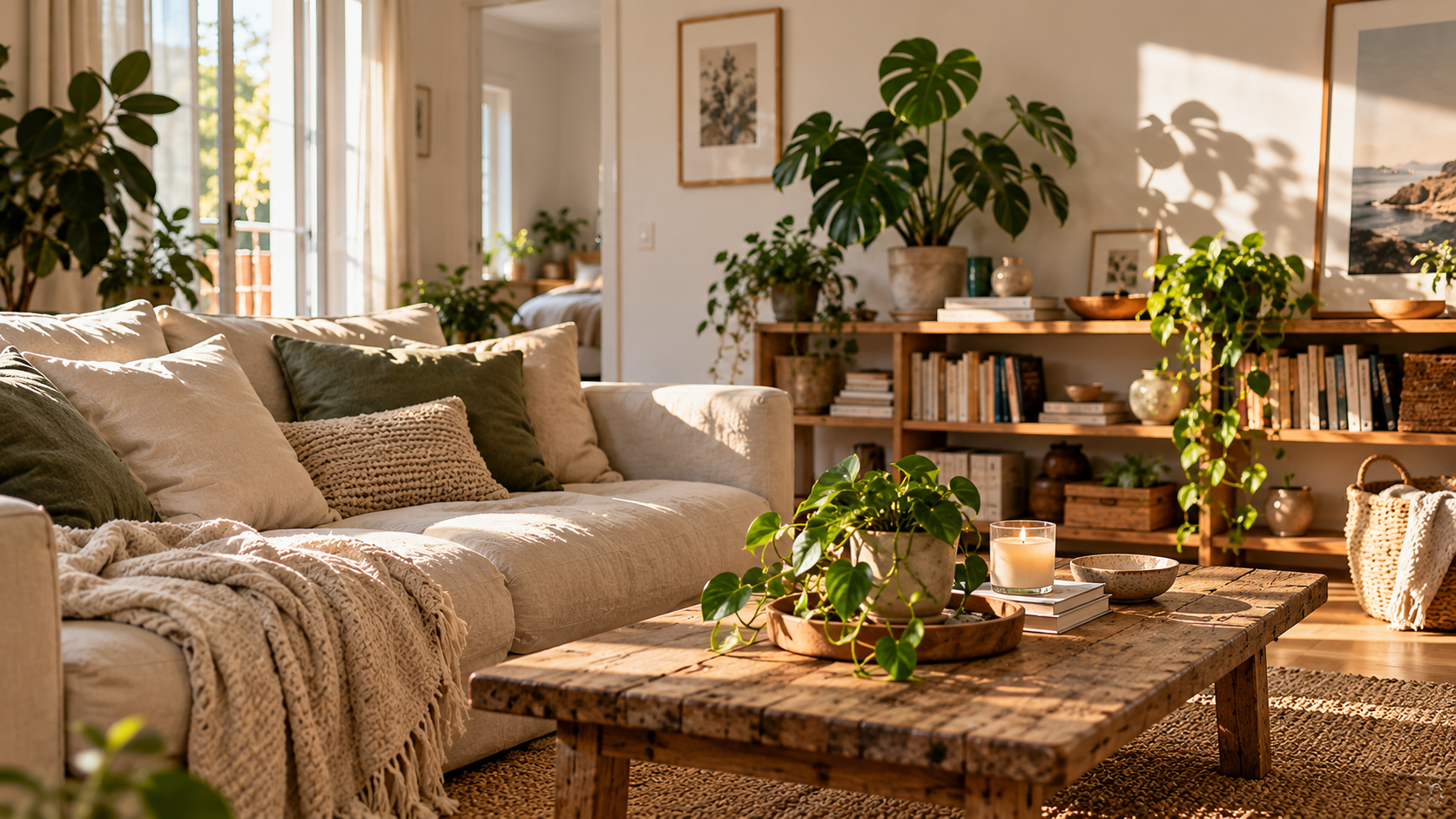
A Calm Home Without Spending a Thing
A calm home isn't about a particular aesthetic or a budget for new furniture. It's about how a space feels when you walk into it — whether it settles you or quietly adds to the noise. The good news is that the changes that matter most don't cost anything. Light, sound, order, and texture: these four elements shape how a room feels more than any purchase could. This guide walks through each one, practically and honestly.
What Actually Makes a Calm Home
A calm home doesn't require minimalist furniture, a neutral colour palette, or an interior designer. Most of what makes a home feel calming or chaotic is invisible — it's the quality of the light, what you're hearing in the background, how much visual noise is in your sight line, and whether the surfaces you touch feel pleasant or harsh.
These aren't abstract ideas. They're physical inputs your nervous system processes constantly, whether you notice them or not. When those inputs are gentle and predictable, the space feels restful. When they're sharp, loud, or cluttered, the space keeps your body slightly on edge — even when you think you're relaxing.
What's worth knowing is that none of this requires money. Soothing interior design, at its core, is about subtraction and adjustment, not acquisition. Whether you're working on soothing living room ideas, thinking about calming office decor, or just trying to make your bedroom feel less hectic, the same principles apply across every room.
Light: The Easiest Thing You're Probably Not Using Well
Natural light is the simplest tool for a calm home environment, and most people block more of it than they realise. Heavy curtains pulled halfway across a window, furniture positioned in front of a glass door, a dark lampshade over the one bulb in the room — these are common habits that dull a space considerably.
Start by looking at your windows at different times of day. Which rooms feel dim by mid-morning? Try pulling curtains fully to the sides rather than just partially. If privacy is the concern, sheer panels — which you may already own — can let light through while still covering the glass.
In the evening, overhead lighting is often the enemy of a calm home. A single bright ceiling light in a living room signals daytime and keeps your mind alert. If you have a floor lamp or table lamp, try switching to that instead after 7pm. The difference in how relaxed the room feels is usually immediate.
A few specific adjustments worth trying:
- Move any furniture that sits directly in front of a window, even by a foot or two
- Replace a dark lampshade with a light-coloured or white one — the bulb doesn't change, but the glow spreads further
- Use lower-positioned lamps (table height, floor height) in evenings rather than overhead lights
- If you work from home, orient your desk so the light comes from the side rather than behind your screen — good calming office ideas often start here
None of these cost anything. They just require noticing what's already there.
Sound: What Destroys the Peace — and What Helps
Sound is probably the most underestimated element in creating a calm home. Most people focus on what they can see and overlook what they're constantly hearing. Background noise — a television left on, a loud appliance, traffic through a single-pane window — creates a low-level stress response that accumulates over hours.
The first honest step is to sit quietly in your home for five minutes without any deliberate sound. Notice what you hear. Often there are things you've tuned out: a noisy fridge, a phone buzzing on a hard surface, the hum of a router, sounds from a neighbouring flat. You can't fix everything, but awareness helps you make choices.
Soft furnishings absorb sound. Rugs, curtains, upholstered seating, cushions, even books on shelves — these all reduce echo and deaden ambient noise. If your space feels loud or echoey, adding one textile layer (a rug on bare floorboards, a curtain on a bare window) makes a measurable difference. This one is genuinely free if you have any soft items in storage. Some people also find that a gentle ambient soundtrack — something in the vein of what brands like dw home calming waves capture with their scent and atmosphere ranges — helps set a consistent auditory tone in the evening.
Things that tend to destroy the peace in a calm home:
- Television or radio running in the background when no one is actively watching or listening
- Phones left on loud notification settings on hard surfaces
- Bare floors and walls, which cause sound to bounce and amplify
- Multiple devices making noise at once, even quietly
Things that help:
- A single chosen sound — rain sounds, ambient music, silence — rather than competing noise sources
- Setting phones to vibrate and placing them on a folded cloth rather than a hard counter
- Putting a rug under a dining table or in a hallway if those spaces feel echoey
Order: Why Decluttering Advice Is Only Half Right
You've probably read that you need to declutter your home to feel calmer. That's true, but the version of it that actually works is more specific. It's not about owning less — it's about where things land in your day-to-day life.
The real issue in most homes isn't clutter in the abstract. It's surfaces. Kitchen counters, the floor just inside the front door, the corner of the bedroom — these become landing zones where things accumulate not because you're disorganised, but because the path to putting something away properly takes more effort than just setting it down.
The phrase that stuck with me: actually put things away instead of just putting them down. It sounds obvious, but it points to something real. When you put something down temporarily, it creates a small unresolved task that sits in your visual field. Multiply that by twenty surfaces and the room quietly hums with incompleteness.
The practical fix isn't willpower. It's making the "away" location easier to reach than the default landing spot. A hook by the door instead of a chair. A small basket for remote controls instead of the floor. A shelf at eye level for frequently used items. You're not adding more discipline — you're reducing friction. The same thinking applies to a calming office — peaceful office decor is less about buying the right desk accessories and more about removing whatever creates visual noise in your direct eyeline.
For a calm home decor approach that doesn't require buying anything:
- Choose one surface per room to keep completely clear, and decide that now
- Remove anything from a surface that hasn't been touched in two weeks
- If you have soothing wall decor or framed prints, take down anything that feels dated or that you've stopped seeing — blank space can be more restful than something you ignore
- Stack books horizontally instead of vertically if you have too many — it reads as less chaotic visually
It's worth noting: some people find visual richness comforting, not stressful. If a full bookshelf or a collection of objects feels good to you, it probably is good for you. The goal isn't a minimalist home feel as an aesthetic — it's a calm home that feels like yours and also lets you breathe.
For more on how visual order connects to a sense of calm, this piece on creating a calm family home covers several practical approaches that work whether you live alone or with others.
Texture: The Quiet Detail That Changes How a Room Feels
Texture is the element most people skip entirely, because it's harder to articulate. But walk into a room with only hard, smooth surfaces — laminate floors, glass table, plastic chairs, bare walls — and notice how it feels. Then walk into one with a wool rug, a linen cushion, a wooden bowl, a woven throw. The second room often feels warmer and quieter even if the layout is identical.
A calm home doesn't require buying new things. Texture is often already in your home, just stored. A blanket in the wardrobe, a cushion in a spare room, a wooden chopping board that lives in a cupboard — these things, placed where you spend time, shift how a space feels without costing anything. This applies just as much to a home office as to a living room: calming office decor and peaceful office decor don't have to mean purpose-bought items. A woven coaster, a ceramic mug you actually like, a small piece of soothing wall decor at eye level — these are enough to change the feel of a workspace.
A few easy moves:
- Fold a blanket over the arm of a sofa rather than storing it away
- Bring a wooden or ceramic object out of the kitchen and onto a shelf in a room where you sit in the evenings
- Put something soft underfoot near where you sit most — even a folded blanket counts
- If you have calming room decor pieces like a soft throw or a woven basket, make sure they're visible and used, not tucked away
Plants fit here too, if you have them. A single plant in a pot doesn't transform a room, but it adds something organic in a space that's otherwise entirely manufactured. The evidence for specific wellness benefits of houseplants is thinner than the internet suggests, so no claims there — but visually, they add texture and a different kind of surface that tends to feel softer to look at.
Putting It Together Without Overwhelming Yourself
The easiest mistake with this kind of thinking is to read it all and then feel like you need to do all of it at once. You don't. Each of these four areas — light, sound, order, texture — can be addressed one room at a time, or one element at a time.
A reasonable starting point: pick the room where you spend the most time unwinding in the evening, and spend twenty minutes on just the light. Move a lamp, pull a curtain back, switch off the overhead. See how it feels for a week before changing anything else.
A calm home is built slowly, through small adjustments you actually notice and keep. It's not a project you complete — it's a way of paying attention to what already affects you, and making small choices accordingly. That's all it is, really. And most of it costs nothing.
Leave a Reply